
Cabinet Sourcing for Dealers & Trade Professionals: How to Simplify Selection, Ordering, and Fulfillment

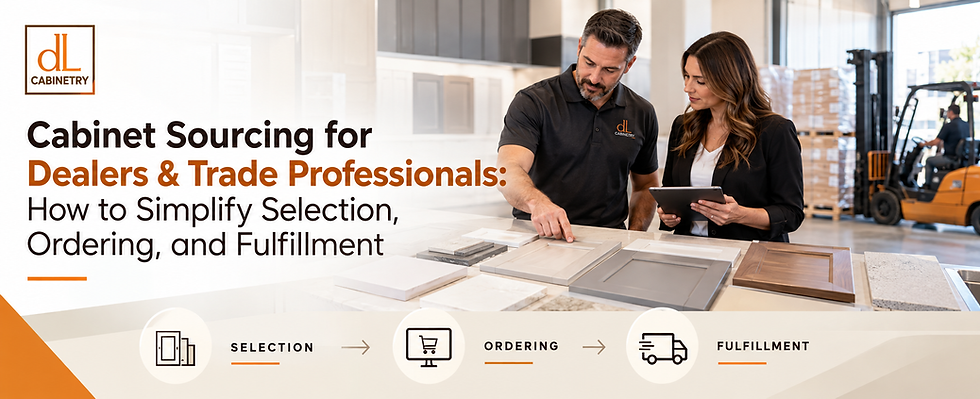
Cabinet sourcing is one of the most repeated — and most overlooked — operational tasks for dealers, remodelers, builders, and other trade professionals. Managing selection, specification, ordering, and fulfillment across multiple projects at once involves more than picking a finish. Professionals must also consider:
Product selection and specification accuracy
Inventory availability and lead times
Order tracking across multiple active projects
Delivery coordination with project schedules
Working with a supplier built for the trade — and a sourcing process built to repeat — can help:
Reduce administrative time spent on selection and ordering
Minimize specification errors
Keep multiple projects on schedule
Improve client and project-manager satisfaction
DL Cabinetry supports dealers and trade professionals with a standardized product lineup, Dealer Portal access, and the fulfillment resources needed to keep repeat projects moving efficiently.

Why Cabinet Sourcing Becomes a Bottleneck for Dealers and Trade Pros
For dealers, remodelers, builders, and contractors managing project pipelines, cabinet sourcing is not a one-time purchase decision — it's a recurring operational function. Search interest around outsourced cabinet sourcing and trade selections continues to grow as more professionals look for ways to reduce coordination time. Sourcing typically breaks down into five core functions:
Selection: choosing door styles, finishes, and accessories across a range of client budgets
Specification: translating a layout into an accurate order with correct dimensions and modifications
Availability: knowing what's in stock versus what requires a longer lead time
Ordering: placing and tracking orders across several active jobs simultaneously
Fulfillment: coordinating delivery with installation and job-site schedules
Most dealers aren't running into trouble on any one of these. It's usually two or three slipping at once — a missed spec here, a delivery that shows up on the wrong day there — that turns sourcing into a job someone has to babysit.
Where Cabinet Sourcing Slows Dealers Down
Several recurring issues account for most sourcing inefficiency:
No Standard Lineup: Without a curated set of go-to products, every project starts from scratch, increasing selection time and client indecision.
Inconsistent Specifications: Specs communicated by phone, text, or handwritten note are a leading cause of dimension errors and missed modifications.
Manual Order Entry: Typing out the same order details every time and then tracking them in a spreadsheet takes longer as volume grows, not less.
Unclear Availability: If stock and lead time aren't visible in real time, giving a client or project manager a date you can actually hit becomes a guess.
Disconnected Delivery Coordination: Cabinets that show up before a site is ready need somewhere to sit. Cabinets that show up late push the install back.
None of these sink a project by themselves. Run enough jobs through a pipeline with all five in play, and the time adds up fast — usually in margin, sometimes in a client who isn't happy with how the project went.
Simplifying Cabinet Selection for Repeat Projects
Reducing sourcing friction starts with cutting the number of decisions made from scratch on every job. A standardized selection process typically includes:
A Curated Core Lineup: A defined set of door styles, finishes, and configurations that cover most standard projects.
Tiered Pricing Options: A good/better/best structure that moves clients through selection faster without sacrificing choice.
Documented Preferred Specs: Templated modifications and hardware upgrades for configurations that come up repeatedly.
This approach doesn't limit what professionals can offer — it keeps the default path fast while custom requests remain the exception. Browsing DL Cabinetry's Collections is a practical starting point for identifying which finishes and styles should anchor a standard trade lineup.
Standardizing Products, Finishes, SKUs, and Specifications
Standardization is what makes repeat ordering accurate and fast. Best practices include:
Consistent SKUs: Using the same product identifiers across every project reduces miscommunication between sales, design, and ordering teams.
A Single Source of Truth: A shared spec sheet, dealer portal, or project management tool that every team member references.
Standardized Finish and Hardware Naming: "The darker one" or "the brushed handles" leads to wrong orders. A written name for each finish doesn't.
It also makes onboarding faster — a new hire can work from a written system instead of learning it second hand from whoever trained them.
How a Streamlined Ordering Process Reduces Errors and Admin Work
Ordering is usually where sourcing inefficiency shows up first. A streamlined process typically includes:
Centralized Order Placement: A single system of record instead of orders scattered across email, calls, and spreadsheets.
Reusable Order Templates: Saved configurations that reduce repetitive data entry on common orders.
Real-Time Order Status: Order visibility that doesn't require a phone call to check.
Fewer Manual Handoffs: Reducing the number of points where information can be lost or miscommunicated.
A wrong SKU or the wrong finish usually doesn't get caught at the point it's entered — it gets caught when the order arrives. Cutting out manual steps is what closes that gap.
What to Look for in a Cabinet Supplier
Not every supplier is built to support the volume and pace trade professionals require. When evaluating a cabinet partner, dealers and trade pros should prioritize:
Inventory Depth and Consistency: Can the supplier reliably fulfill a standard lineup without frequent stockouts or substitutions?
Realistic Lead Times: Accurate communication — and a track record of meeting it — matters more than the fastest quoted timeline.
Responsive Communication: How quickly can order changes get a real answer?
Fulfillment Flexibility: Can deliveries be staged, dropped at the job site, or received at a warehouse — whatever fits the schedule?
Trade-Specific Support: Dedicated account help and dealer pricing usually mean the supplier is built for professionals, not retail traffic that happens to buy in volume.
A good supplier relationship takes coordination off your plate, not adds to it. DL Cabinetry's Free Kitchen Design service and on-site warehousing at every location are built around exactly this kind of trade support.
Digital Dealer and Trade Tools That Make Repeat Ordering Easier
Modern dealer and trade portals are purpose-built to solve the friction points above. The right tools typically provide:
Saved Product and Spec Libraries: Fast reordering of standard configurations.
Order Tracking and History: Status visibility without a phone call.
Trade-Specific Pricing and Account Management: Centralized in a single login.
Direct Availability and Lead Time Data: Real-time answers instead of back-and-forth communication.
For a dealer running several projects at once, that's the difference between chasing an answer and already having it. The DL Cabinetry Dealer Portal gives registered professionals real-time inventory visibility, dealer pricing, and instant shipping quotes — the same functions covered in our guide to RTA wholesale and drop shipping for dealers.
Cabinet Sourcing Checklist for Dealers and Trade Professionals
☐ Curated core lineup of door styles, finishes, and configurations
☐ Documented, consistent specifications for standard and custom orders
☐ Standardized SKU and finish naming across the team
☐ Centralized system for placing and tracking orders
☐ Clear visibility into supplier inventory and lead times
☐ Defined process for coordinating delivery with project schedules
☐ Reliable point of contact for order changes or issues
☐ Access to a dealer/trade portal for reordering and account management
A Cabinet Sourcing Partner for Dealers and Trade Professionals
Having a dependable cabinet sourcing partner can make all the difference in:
Keeping multiple projects on schedule
Reducing administrative and ordering errors
Improving client and project-manager satisfaction
DL Cabinetry offers a standardized, in-stock product lineup, competitive dealer pricing, and a Dealer Portal built for repeat ordering. From selection and specification through ordering and fulfillment, our team helps dealers and trade professionals get jobs done on time and without the usual back-and-forth.
Ready to Simplify Cabinet Sourcing for Your Business?
Become a Dealer for trade pricing, dedicated support, and streamlined ordering — or Talk to Our Trade Team to see how DL Cabinetry can fit into your project workflow.
FAQs
What should trade professionals prioritize when choosing a cabinet supplier?
Reliable inventory, honest lead times, and someone who actually answers when an order needs to change — those tend to matter more day to day than shaving a few points off the price.
How can dealers reduce the time spent on cabinet selection?
Build a core lineup and price it in tiers. Fewer open-ended choices means clients move through selection faster, and your team spends less time re-explaining the same options.
What causes most cabinet ordering errors?
Usually vague specs and manual data entry — someone retyping details from a phone note or memory. Standard SKUs and a centralized order system cut that down a lot.
How do dealer portals help with repeat cabinet ordering?
Product library, order history, pricing, and stock levels all sit in one login, so a repeat order doesn't mean rebuilding information you already had.
Why is standardizing SKUs and finishes important for trade professionals?
It keeps sales, design, and ordering working from the same information, so a mismatched finish or the wrong code doesn't slip through unnoticed.


